





Old Torrance asks 3% less than Torrance as a whole.
Torrance, California · Neighborhood guide
Old Torrance
Torrance's original 1912 townsite, where pre-war bungalows still sit on Olmsted's grid around a small downtown
Median askingOld Torrance$872K16 for sale
See homesOld Torrance, in short.
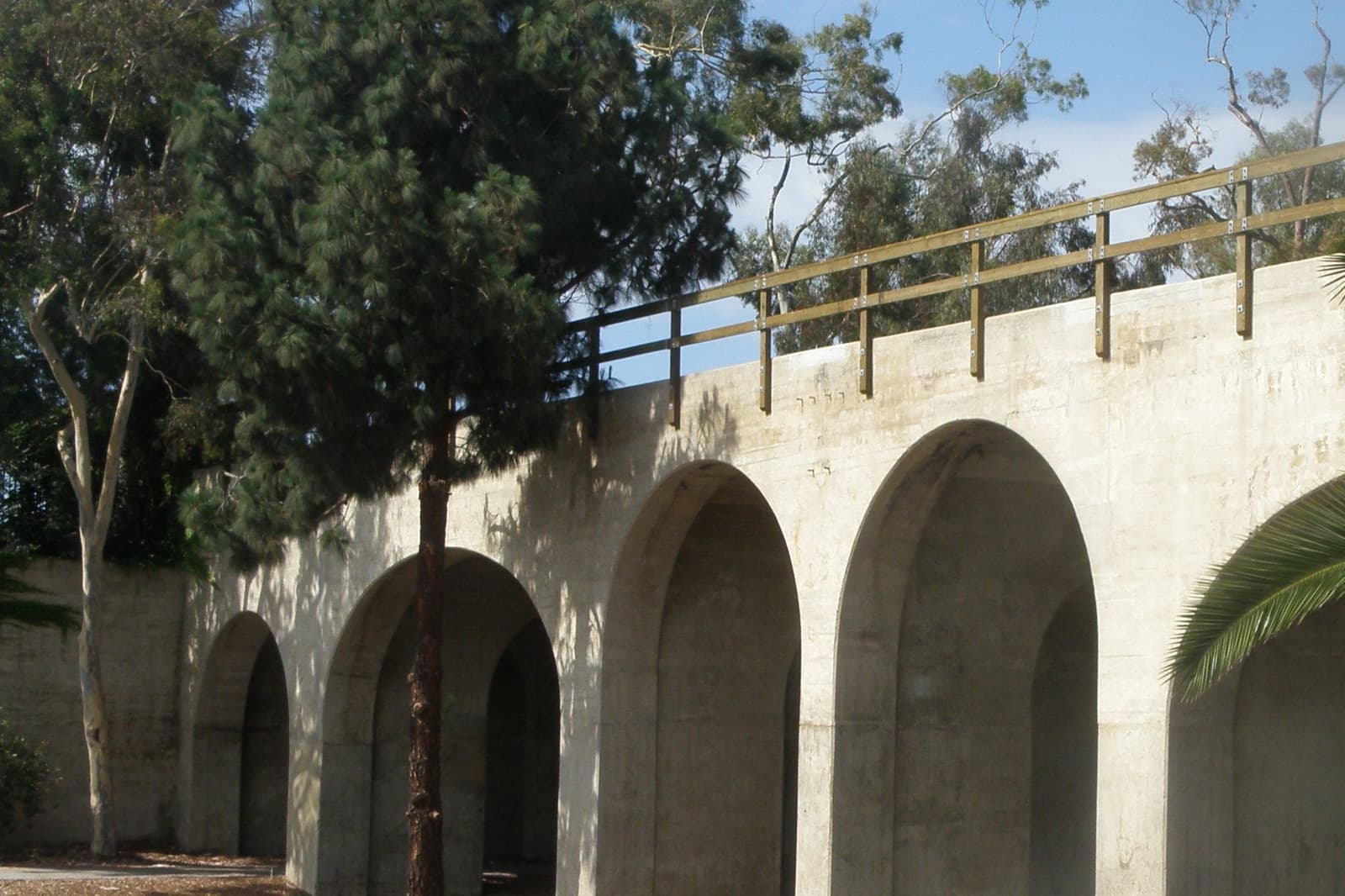
Old Torrance, also called Downtown Torrance, is the residential core of the city's original 1912 townsite, planned by Frederick Law Olmsted Jr. for founder Jared Sidney Torrance, between Western Avenue and Crenshaw Boulevard from Dominguez Street south to Plaza del Amo. County assessor records show about 790 detached houses, 93 percent of them built between 1910 and 1949, on lots that mostly run 4,500 to 5,800 square feet, plus about 950 condos and townhomes, mostly from the 1990s and 2000s. As of September 2026, condos and townhomes asked about $385,000 to $1 million, and the few houses for sale about $780,000 to $1.7 million. Torrance High (1917) and Irving Gill's 1913 El Prado Bridge are on the National Register.
Old Torrance by the numbers.
- 12,121Population
- 49%Bachelor's degree or higherage 25+
- $102,997Median household income
- 41.6Median age
- 1912FoundedOlmsted's 109-block plan
- 1921IncorporatedMay 12, with 1,800 residents
Sources: U.S. Census Bureau, ACS 5-year 2019–2023; neighborhood facts compiled by The Slava House.
Torrance's original townsite
A town planned in 1912 that you can still read block by block.
Old Torrance is where the city started, and most of its houses date from the town's first four decades. In 1912 founder Jared Sidney Torrance had Frederick Law Olmsted Jr. lay out a planned industrial town on ranch land east of Redondo Beach, with Irving Gill as resident architect. The 109-block tract they drew, with separate residential, commercial, and industrial districts, still reads clearly on a map.
We map it the way the city's Torrance Tract overlay does: Dominguez Street on the north, Western Avenue on the east, Plaza del Amo and Carson Street on the south, and Crenshaw Boulevard on the west. Its spine is El Prado Avenue, the landscaped parkway Olmsted aligned on Mount San Antonio, which runs into the downtown grid of Sartori, Cabrillo, and Marcelina avenues. The factory blocks north of Dominguez were part of the same plan but aren't residential.
Two of Gill's works are still downtown. His 1912 Pacific Electric depot still stands on Cabrillo Avenue, though the Depot restaurant that has filled it since 1991 has posted a farewell for September 30, 2026. His 1913 concrete rail bridge over Torrance Boulevard has been on the National Register of Historic Places since 1989. Torrance High School, opened in 1917 and also on the Register, holds the southwest corner at Carson Street.
The housing comes in two layers. County assessor records show about 790 detached houses, 93 percent built between 1910 and 1949, and about 950 condos and townhomes, most built in the 1990s and 2000s near downtown. Another 325 lots hold duplexes and about 230 hold three or more units. Prices sit below the city's hillside and coastal neighborhoods.
Old Torrance is not a designated historic district, but two sets of rules apply. The city adopted a Historic Preservation Plan in 2017 and has named ten houses local landmarks since October 2022. Separately, the Torrance Tract overlay sends teardowns, facade changes, and large additions on surveyed older houses to the Planning Commission.

Live from the MLS
Old Torrance compared with all of Torrance.
A square foot in Old Torrance costs 9% more than across Torrance.
Old Torrance$668
All of Torrance$615
Listings in Old Torrance have been on the market about as long as across Torrance.
What’s for sale
38% of the homes for sale in Old Torrance are condos.
- Condo38%6 homes
- Townhouse25%4 homes
- Single-family19%3 homes
- Multi-unit19%3 homes
Homes for sale in Old Torrance are 20% smaller than across Torrance.
Old Torrance1,090 sq ft
All of Torrance1,361 sq ft
Each card sets the median in Old Torrance against all of Torrance. The arrow on a card lists every Torrance neighborhood we cover. Asking prices for homes on the market right now inside each mapped area, not sale prices. Updated October 3, 2026, 5:00 PM PT
Homes for sale in Old Torrance
16 active listings in the mapped area
$1,220,000
Townhouse3 bd3 ba2,030 sqft
1800 Oak 515
$1,800,000
Quadruplex
1814 Martina Ave
$699,000
Condo2 bd2 ba897 sqft
1301 Cabrillo 207
$895,000
Townhouse2 bd3 ba1,330 sqft
1800 Oak Street 319
$384,990
Condo1 bd1 ba560 sqft
1211 Cabrillo
$849,000
Single-Family2 bd1 ba788 sqft
719 Columbia Place
$909,000
Condo3 bd3 ba1,660 sqft
1626 Gramercy Avenue
$495,000
Condo1 bd1 ba741 sqft
2367 Jefferson St 110
$1,025,000
Townhouse4 bd3 ba1,800 sqft
1624 Gramercy
$1,690,000
Duplex
1828 Andreo
$1,690,000
Single-Family3 bd3 ba2,610 sqft
1828 Andreo
$780,000
Single-Family2 bd1 ba876 sqft
2063 W 220th Street
$549,000
Condo1 bd1 ba856 sqft
2367 Jefferson 312
$799,000
Condo2 bd2 ba1,090 sqft
2349 Jefferson Street 413
$2,195,000
Apartment
1751 Martina Avenue
$835,000
Townhouse3 bd3 ba1,487 sqft
832 Arlington

Still deciding? Ask me.
I’m a Realtor based in Long Beach, and Torrance is one of the cities I work most. Tell me what you’re after in Old Torrance and I’ll help you get there.
Slava Ploshkin · DRE #02323623English and Russian · How I work in Torrance
Where to eat, shop, and explore in Old Torrance
The restaurants, cafes, shops, parks, and landmarks that give Old Torrance its everyday character, most within a short walk.
12 places
Pick one and I’ll show you where it is.
Shopping5 min walk
The parkway Olmsted drew as the town's spine in 1912, landscaped down the middle and aligned on Mount San Antonio (Mount Baldy), running into the downtown blocks of Sartori and Cabrillo.
Park once near Sartori and El Prado; the whole downtown is a few blocks on foot.
Landmark10 min walk
Irving Gill's 1912 Pacific Electric station at 1250 Cabrillo Avenue, the end of the Red Car line that built the town. Chef Michael Shafer's Depot restaurant has used it since 1991 and posted a farewell for September 30, 2026.
Restaurant5 min walk
Oaxacan cooking and a mezcal list at 1261 Cabrillo Avenue, a block from the depot.
The restaurant lists free parking in its building.
Coffee5 min walk
The bakery at 1341 El Prado Avenue for coffee, cakes, and bread; its cookies are what the historical society serves on its home tour.
Coffee5 min walk
A South Bay roaster's downtown Torrance shop at 1413 Marcelina Avenue, a block off Sartori.
Nightlife5 min walk
The brewpub at 1266 Sartori Avenue, open since August 2000 as Torrance's first brewery and named for the Pacific Electric Red Cars that ended their run a block away.
Landmark15 min walk
Irving Gill's 1913 concrete arch bridge over Torrance Boulevard at Bow Avenue, built for the Pacific Electric and on the National Register of Historic Places since July 13, 1989. It has been on the Torrance police logo since 2000.
Landmark5 min walk
Opened September 11, 1917, with four buildings on the National Register since 1983. Louis Zamperini graduated here in 1936, and the campus has been a set for Beverly Hills, 90210 and Buffy the Vampire Slayer.
Landmark5 min walk
The society's museum at 1345 Post Avenue, open Wednesday, Thursday, and Sunday from noon to 4. Free Old Torrance walking tours start here on the fourth Sunday of the month, May through October.
Tours start at 10:30 a.m. and cover about eight blocks in roughly 90 minutes; no reservation needed.
Park5 min walk
A 2.88-acre strip of lawn and trees running three blocks along El Prado from Cravens Avenue to Manuel Avenue; the city notes that el prado means the meadow.
Park · Nearby15 min walk
Charles H. Wilson Park, the city's largest, on Crenshaw Boulevard, with a 0.91-mile fitness path, batting cages, and a roller hockey rink. The Torrance Certified Farmers' Market sets up here every Tuesday and Saturday from 8 to 1.
The market is at 2400 Jefferson Street and runs rain or shine; the splash pad is open April through December.
Nightlife · Nearby25 min walk
A taproom at 1901 Del Amo Boulevard, in the industrial blocks north of the neighborhood that the Olmsted plan set aside for factories.
A model industrial town, 1911 to 1921
An Olmsted plan on ranch land, and an architect who got fired.
The land was part of Rancho San Pedro, the Dominguez family's Spanish grant. In 1911, Pasadena businessman Jared Sidney Torrance and his Dominguez Land Company bought nearly 2,800 acres east of Redondo Beach for a model industrial town. The Union Tool Company promised a $500,000 plant, and ground was broken on February 6, 1912. The town was nearly called Dominguez; in March 1912 the company named it for its founder instead.
Torrance paid Olmsted, son of the designer of Central Park, $10,000 to plan the town. Olmsted kept homes within walking distance of the factories but put the factories downwind, and drew El Prado as a parkway with a civic center around it. The Pacific Electric and the Southern Pacific agreed to extend their lines, and the company declared the town open on October 28, 1912. The plan also set aside one corner for 'non-Caucasians,' and deed restrictions kept people of color out of the rest of town for decades.
Gill's houses were ahead of their time and didn't sell. He planned about 100 plain, unornamented worker cottages; about ten were built, on the 1800 and 1900 blocks of Gramercy Avenue, because buyers wanted the decorated California bungalow. Accounts differ on how many survive, and one architecture survey counts a single house. Gill didn't last on the job either; he was fired.
Growth was slow. Three years after the founding the town had 350 residents, and 1,800 when Torrance incorporated on May 12, 1921. Oil was found under the city late that year, and derricks went up among the houses. Torrance High opened on September 11, 1917, and Louis Zamperini, the Olympic runner the city airport is named for, graduated there in 1936.
The Torrance Historical Society surveyed every structure in the Olmsted Tract between 2011 and 2013, and that survey became the base of the city's 2017 preservation plan. The society runs a free docent-led walking tour from its museum at 1345 Post Avenue on the fourth Sunday of each month, May through October, and a tour of historic homes every other year, next on October 10 and 11, 2026.
- Nearly 2,800 acres bought in 1911; town declared open October 28, 1912
- Olmsted Jr. planned the 109-block town for $10,000; Gill was resident architect
- Incorporated May 12, 1921, with 1,800 residents; Torrance High opened in 1917
Pre-war bungalows and newer condos on the Olmsted grid
Craftsman and Spanish cottages from the 1910s to the 1940s, and 1990s and 2000s condos near downtown.
The residential district is a grid of pre-war houses. Gramercy and Andreo were the first residential avenues. By assessor records, the typical detached house was built around 1927 and has about 1,230 square feet on a lot of about 5,100; the middle half of lots run 4,500 to 5,800 square feet. The mix is Craftsman bungalows, Spanish Colonial Revival and Mission Revival cottages, a few Tudors, and plainer houses from the late 1930s and 1940s, on blocks with mature street trees.
Condition varies more than style. After a century of remodels, original detail, permitted additions, and the state of the foundation, roof, and systems drive value more than square footage. The city has designated ten houses as local landmarks, the first on Arlington Avenue in October 2022 and the latest on Andreo Avenue in June 2026, with others on Acacia, Gramercy, Post, El Prado, and Sonoma. Designation needs the owner's written consent.
The other half of the housing is newer. About 950 condos and townhomes sit near downtown and along the main roads, and about four in five were built between 1990 and 2009. They're the usual way in, and in September 2026 they made up most of the listings here.
- About 790 detached houses, 93% built 1910 to 1949; typical lot about 5,100 sq ft
- About 950 condos and townhomes, most built 1990 to 2009
- Ten city landmark houses since 2022; originality and permits drive value
Downtown, on El Prado and Sartori
A few blocks of restaurants and bars, and an antique faire once a month.
Downtown Torrance is a few blocks you can walk end to end. Sartori, Cabrillo, and El Prado avenues hold the restaurants and bars. Red Car Brewery on Sartori opened in 2000 as the city's first brewery, Madre's Oaxacan kitchen is on Cabrillo, Torrance Bakery is on El Prado, and Offset Coffee has a shop on Marcelina. The Depot, in Gill's station, has announced its last meal for September 30, 2026.
The Antique Street Faire fills downtown on the fourth Sunday of every month from 8 to 3, free, with a $3-an-item appraisal booth. The Torrance Certified Farmers' Market runs Tuesday and Saturday mornings from 8 to 1, rain or shine, at 2400 Jefferson Street in Wilson Park. Each May the Armed Forces Day Parade runs down Torrance Boulevard; the city first held it in 1960, and May 2026 was the 64th.
The historical society's museum at 1345 Post Avenue is open Wednesday, Thursday, and Sunday afternoons, and its walking tour is the best introduction to the district. El Prado Park, 2.88 acres of lawn and trees along the parkway from Cravens Avenue to Manuel Avenue, is the neighborhood green. Wilson Park, the city's largest, sits on Crenshaw Boulevard off the southwest corner, with a fitness path, batting cages, a roller hockey rink, and a splash pad.

- Restaurants, a brewpub, a bakery, and coffee on Sartori, Cabrillo, and El Prado
- Antique faire every fourth Sunday; farmers' market Tuesdays and Saturdays
- Armed Forces Day Parade since 1960; museum open Wed, Thu, and Sun afternoons
Preservation rules and the nearby refinery
What to verify on a century-old house in a townsite the city is still deciding how to protect.
The overlay catches buyers off guard, so read it first. The Torrance Tract overlay, Article 49 of the zoning code, covers residential lots in the townsite that hold a house the 2011 to 2013 survey rated contributing or altered-contributing. On those lots, demolishing any part of the old house, changing its street facade, adding a driveway curb cut, or building past a floor-area ratio of 0.5, garage included, needs Planning Commission review. Reroofing with period materials, historically accurate windows, fences, and a detached accessory building don't. Ask the Planning Division how the survey rated a house before you write an offer.
Landmark and district rules are a second layer. Under the 2017 ordinance, exterior work on a designated landmark or inside a designated district goes through historic review, and a Mills Act property-tax contract is available only after designation. No district has been designated yet. The city has a draft update of the plan out for public review that would extend it to downtown's commercial buildings.
Age is the next problem. Homes from the 1910s to the 1940s can have original foundations, old wiring and plumbing, and additions of uneven quality. I'd inspect the structure, roof, sewer lateral and systems, and find out which past work was permitted. I'd hold back a real repair budget on any house that hasn't been redone.
The refinery is closer than most buyers expect. The Torrance Refinery, run by PBF Energy since it bought the plant from ExxonMobil in 2016, fills the blocks between 190th Street and Del Amo Boulevard. Its south fence is less than half a mile north of Dominguez Street and under a mile from El Prado. The February 18, 2015 explosion there threw debris that narrowly missed a tank holding tens of thousands of pounds of modified hydrofluoric acid. In 2019 the South Coast AQMD shelved a proposed rule that could have phased the acid out and took safety commitments from the refinery instead. Flaring still happens, and the AQMD posts flare notices online.
Zamperini Field, the city airport, is about 2.5 miles southwest; check the city's NoiseLab flight tracks for your block anyway. FEMA maps the whole neighborhood as Zone X, minimal flood hazard, and the 2025 state fire-hazard map leaves it out of the hazard zones.
- Torrance Tract overlay: teardowns, facade changes, and FAR over 0.5 need review
- Inspect foundations, systems, and past permits on 1910s to 1940s houses
- Refinery fence under half a mile north; FEMA Zone X; no fire-hazard zone
How the Old Torrance market works
Two products in one district, pre-war houses and newer condos, both priced below the hills and the coast.
Old Torrance draws buyers who want an older house or a walkable condo in central Torrance without paying for the Hollywood Riviera or the hillside tracts. As of September 2026, most listings inside our map were condos and townhomes asking about $385,000 to $1 million. Only a handful of detached houses were for sale, asking about $780,000 to $1.7 million.
Within the district, price turns on the block, the style and originality of the house, the condition of its systems, and any permitted addition or second unit. The overlay matters too: a house the survey rated contributing needs Planning Commission review for a teardown or a big addition, which is worth knowing before you plan one.
A restored 1920s bungalow and a 2007 condo have little in common, so a district average tells you almost nothing. I price street by street, off comparable sales.
- Condos and townhomes asked about $385K to $1M in September 2026
- Detached houses are scarce; block, originality, and systems drive price
- Overlay review affects teardowns and big additions on surveyed houses
Getting around Old Torrance
Downtown is on foot, and the express bus to Union Station leaves just past the northwest corner.
From most blocks you can walk to downtown, El Prado Park, Torrance High and Wilson Park. Anything past that means a car, and the main roads out are Torrance Boulevard, Carson Street, Western Avenue and Crenshaw Boulevard.
For the region, the 405 is north via Crenshaw or Western, and the 110 is east via Carson Street or Torrance Boulevard. Del Amo Fashion Center, about 2.5 million square feet of stores, is about two miles west at Hawthorne and Carson. The Mary K. Giordano Regional Transit Center at 465 Crenshaw Boulevard, just past the neighborhood's northwest corner, opened on June 9, 2023, with 250 parking spaces, and Torrance Transit's 4X runs express from there to Union Station. Metro plans to end its K Line extension at that center; the final environmental report came out in September 2025, and Metro expects service by 2036.
More Old Torrance facts
- 93%Pre-war housesOf about 790 detached houses, built 1910 to 1949
- 10City landmarksHouses designated October 2022 to June 2026
- 1917Torrance HighNational Register since 1983
- 1913El Prado BridgeIrving Gill; National Register 1989

Rentals in Old Torrance
4 active rentals in the mapped area
Renting in Old Torrance
Yes. There's a real rental layer here: condos and townhomes near downtown, units in the duplexes and small apartment buildings along Torrance Boulevard and Western Avenue, and now and then a bungalow.
Questions & answers
Yes, if you want a pre-war house or a newer condo a short walk from a small downtown and can live with a refinery less than a mile north. Most detached houses are Craftsman and Spanish bungalows from 1910 to 1949 on Olmsted's grid, near the downtown blocks, Torrance High, and Wilson Park. Prices sit below the Hollywood Riviera and the hillside tracts. What you live with: century-old systems, overlay review on big changes to surveyed houses, and the refinery and industrial district to the north.
Explore near Old Torrance
2.9 mi awayWalteriaSouthwest Torrance's 1950s and 1970s streets under the Palos Verdes hills, with an 1880s name and the airport across the highwayRead the guide ›3.6 mi awayHollywood RivieraTorrance's beach hill, Clifford Reid's 1928 tract that mostly got built in the 1950s, with Riviera Village a walk away in Redondo BeachRead the guide ›4.8 mi away · Palos Verdes EstatesMalaga CoveThe first streets the Olmsteds drew, still centered on a 1920s arcaded plazaRead the guide ›5.3 mi away · Palos Verdes EstatesMontemalagaBig midcentury lots 800 to 1,000 feet up the Palos Verdes Estates hillside, with the Queen's Necklace below at nightRead the guide ›5.5 mi away · Rancho Palos VerdesMiralesteThe Peninsula's 1920s east slope, under old pines, with the harbor lit up belowRead the guide ›5.9 mi away · Manhattan BeachHill SectionThe biggest lots west of Sepulveda, on a slope south of Manhattan Beach Boulevard that climbs to about 225 feetRead the guide ›
Where we check the facts
The facts in this guide (districts, zones, rules) come from the official records below. We re-check them before property tours.
- City of Torrance — Historic Preservation Programtorranceca.gov2017 ordinance, Olmsted Tract survey, ten landmarks, Mills Act, plan update
- Torrance Municipal Code — Article 49, Torrance Tract Overlay Zonecodepublishing.comoverlay boundaries and Planning Commission review triggers
- PBS SoCal, Lost LA — Torrance at 100pbssocal.orgland purchase, Olmsted fee, Gill, Union Tool, opening, deed restrictions, incorporation
- National Register of Historic Places (NPS)npgallery.nps.govTorrance High School (1983); El Prado Bridge listed 1989
- Torrance Historical Societytorrancehistoricalsociety.orgmuseum hours, 2026 historic home tour
- City of Torrance — Walking Tour of Historic Old Torrancetorranceca.govfourth Sundays May to October, eight blocks, 90 minutes
Show all 13 sourcesShow fewer
- Torrance Unified School District — School Locatorschoolsitelocator.comattendance areas by address
- Los Angeles County Assessorportal.assessor.lacounty.govparcel use codes, year built, lot and house sizes (2020 roll)
- U.S. Chemical Safety Board — Torrance refinery reportcsb.govFebruary 18, 2015 explosion, 2017 report, 2016 sale to PBF
- South Coast AQMD — Proposed Rule 1410 (hydrogen fluoride)aqmd.gov2019 safety commitments in place of a rule
- City of Torrance — Airport Noise Abatementtorranceca.govZamperini Field noise program and NoiseLab
- FEMA Flood Map Service Centermsc.fema.govflood zones by address
- CAL FIRE / OSFM: 2025 LRA Fire Hazard Severity Zones map service (map dated March 24, 2025)utility.arcgis.comno Moderate, High or Very High zone inside our map, checked September 2026
Photo credits (7)
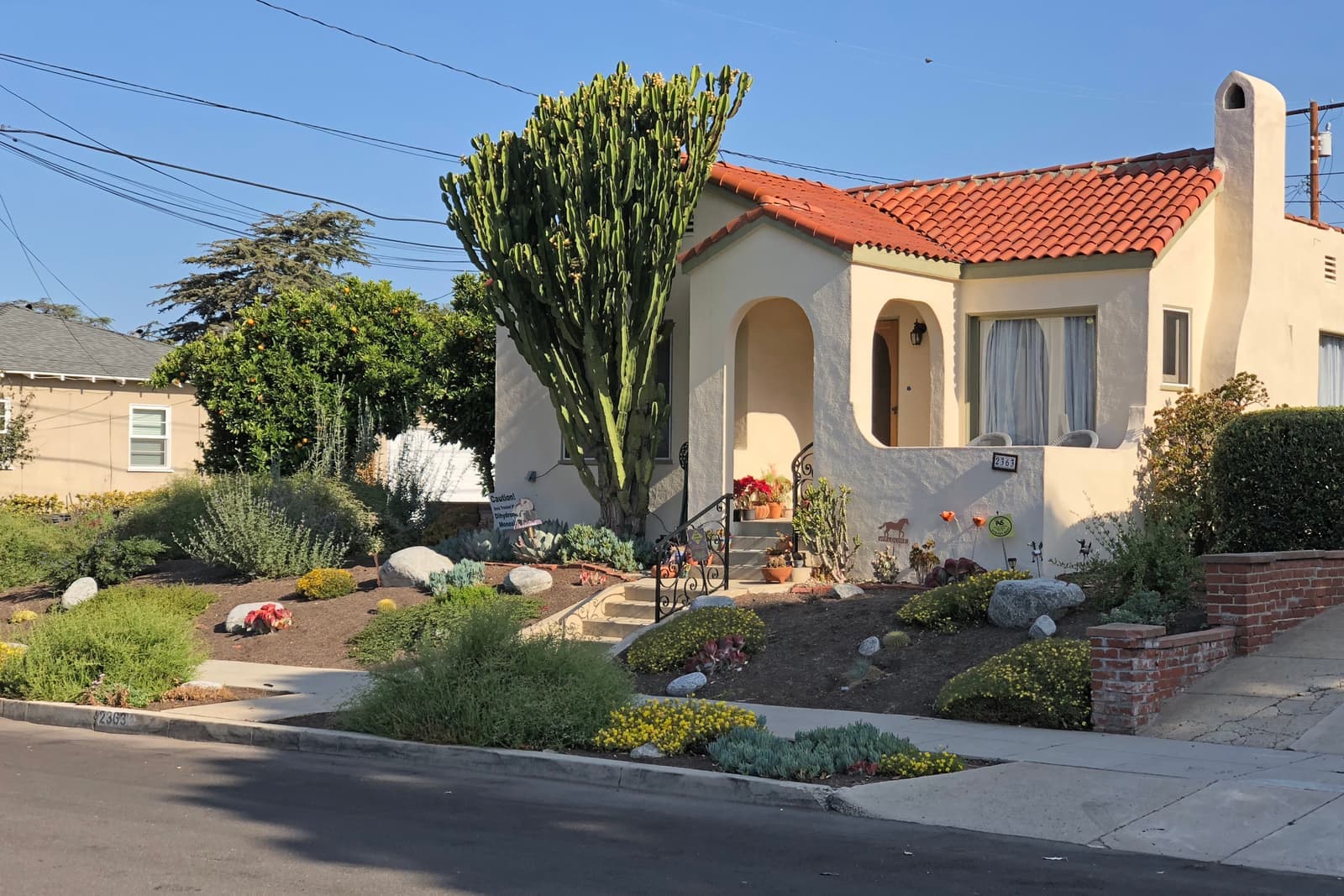
- A Spanish style bungalow with a drought-tolerant garden on El Dorado Streetmark6mauno (Flickr), CC BY 2.0
- The bell tower of First Baptist Church in Old Torrance, under a clear blue skyvagueonthehow (Flickr), CC BY 2.0
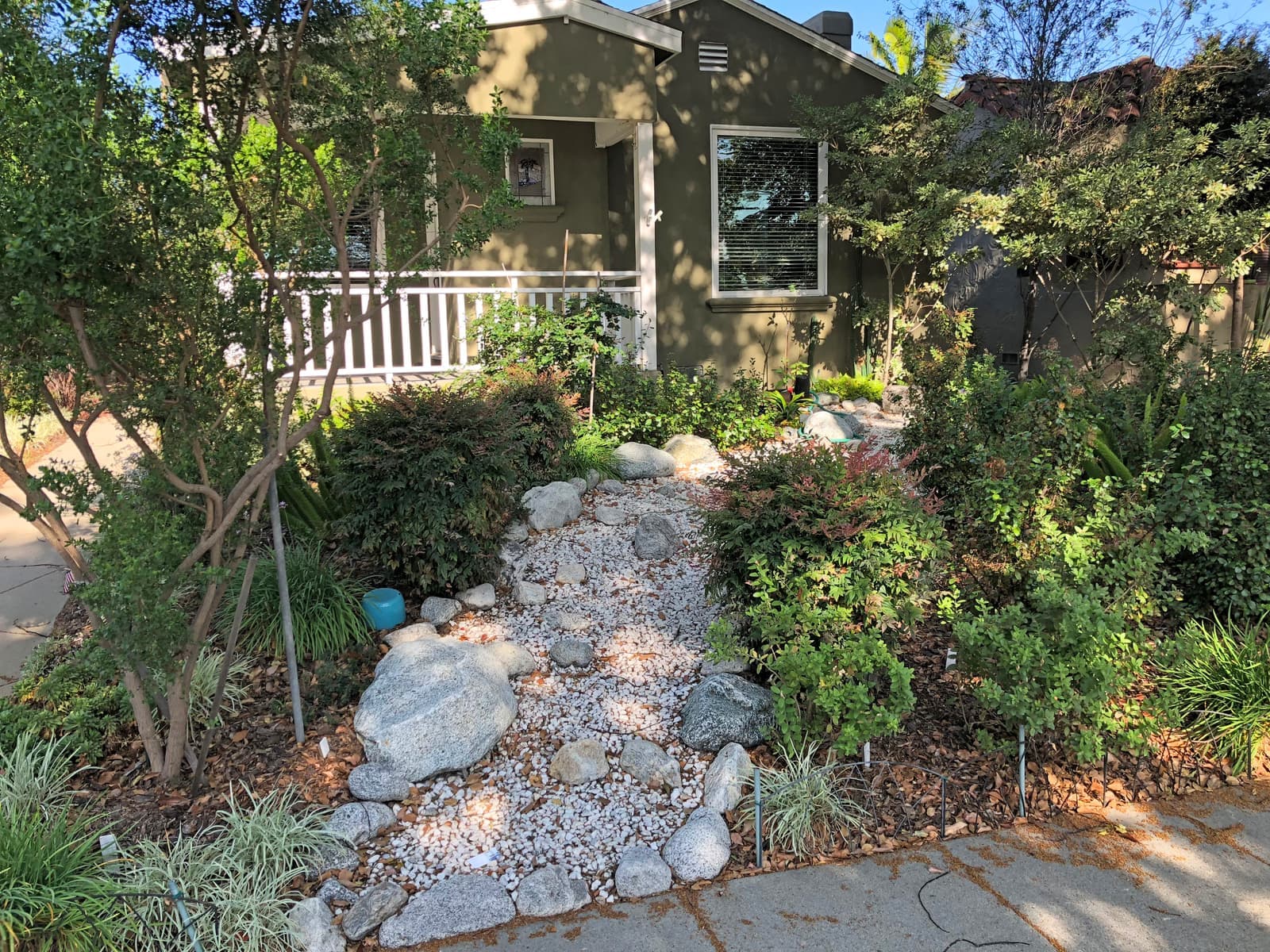
- A bungalow porch on Beech Avenue behind a dry creek garden of stones and shrubsmark6mauno (Flickr), CC BY 2.0
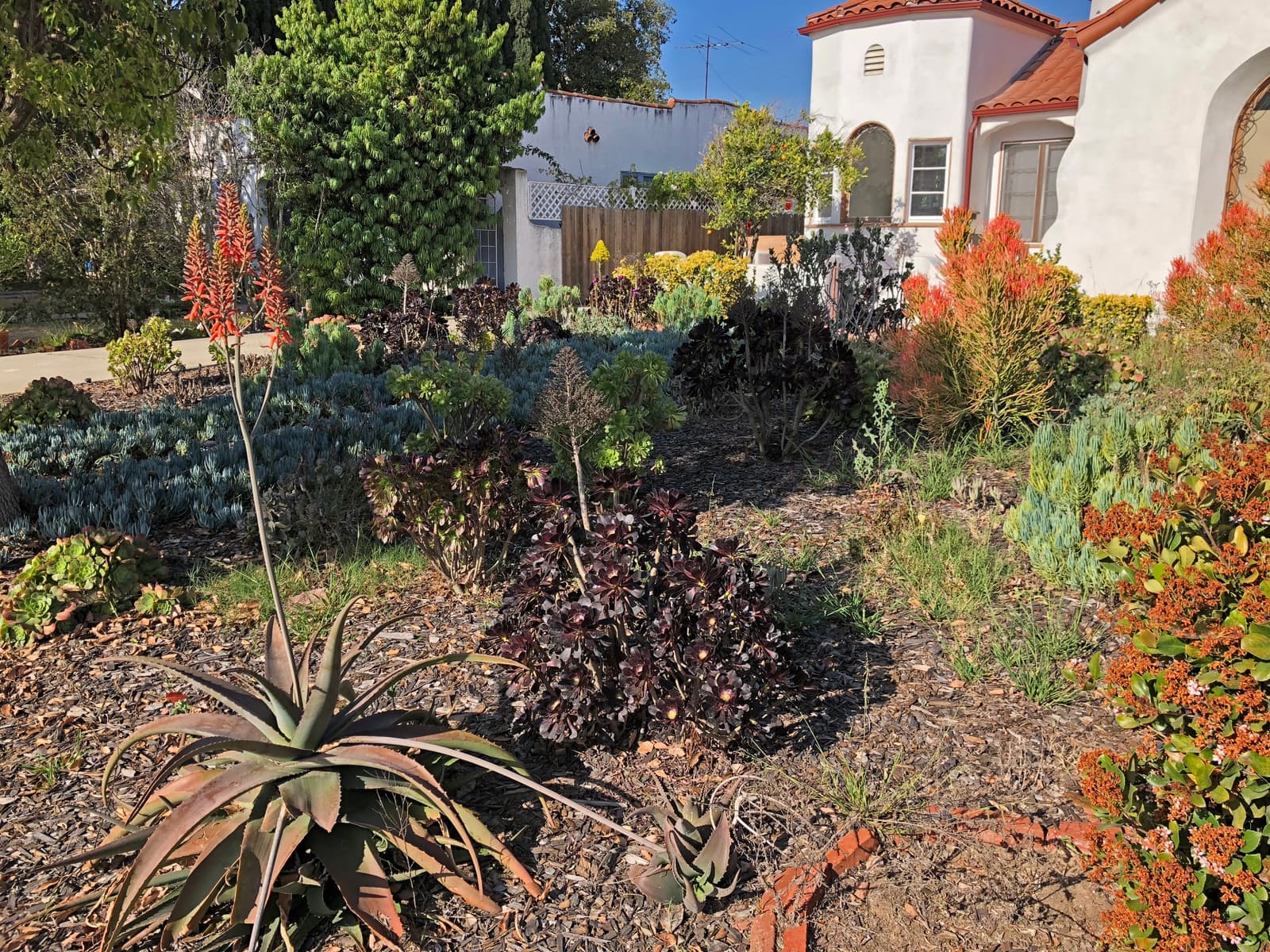
- An aloe in bloom in a front garden on Cota Avenue, with a Spanish style house behindmark6mauno (Flickr), CC BY 2.0
- Irving Gill's 1912 Pacific Electric depot on Cabrillo Avenue in downtown TorranceRon Reiring, CC BY-SA 2.0, cropped
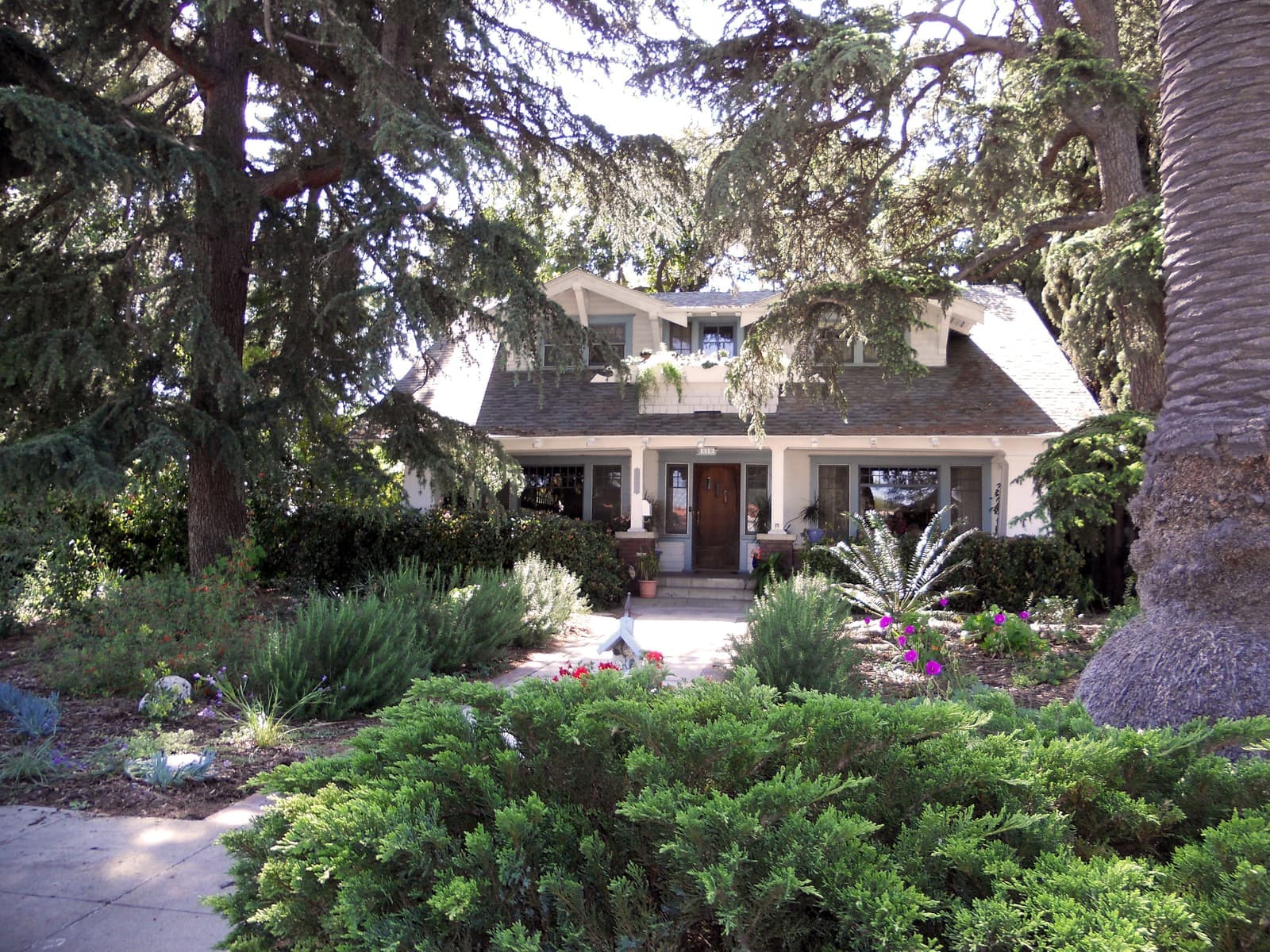
- A Craftsman bungalow under old cedars on a quiet street in Old TorranceKurt Thomas Hunt, CC BY 2.0
- Irving Gill's 1913 concrete rail bridge over Torrance BoulevardLaurie Avocado, CC BY 2.0, cropped